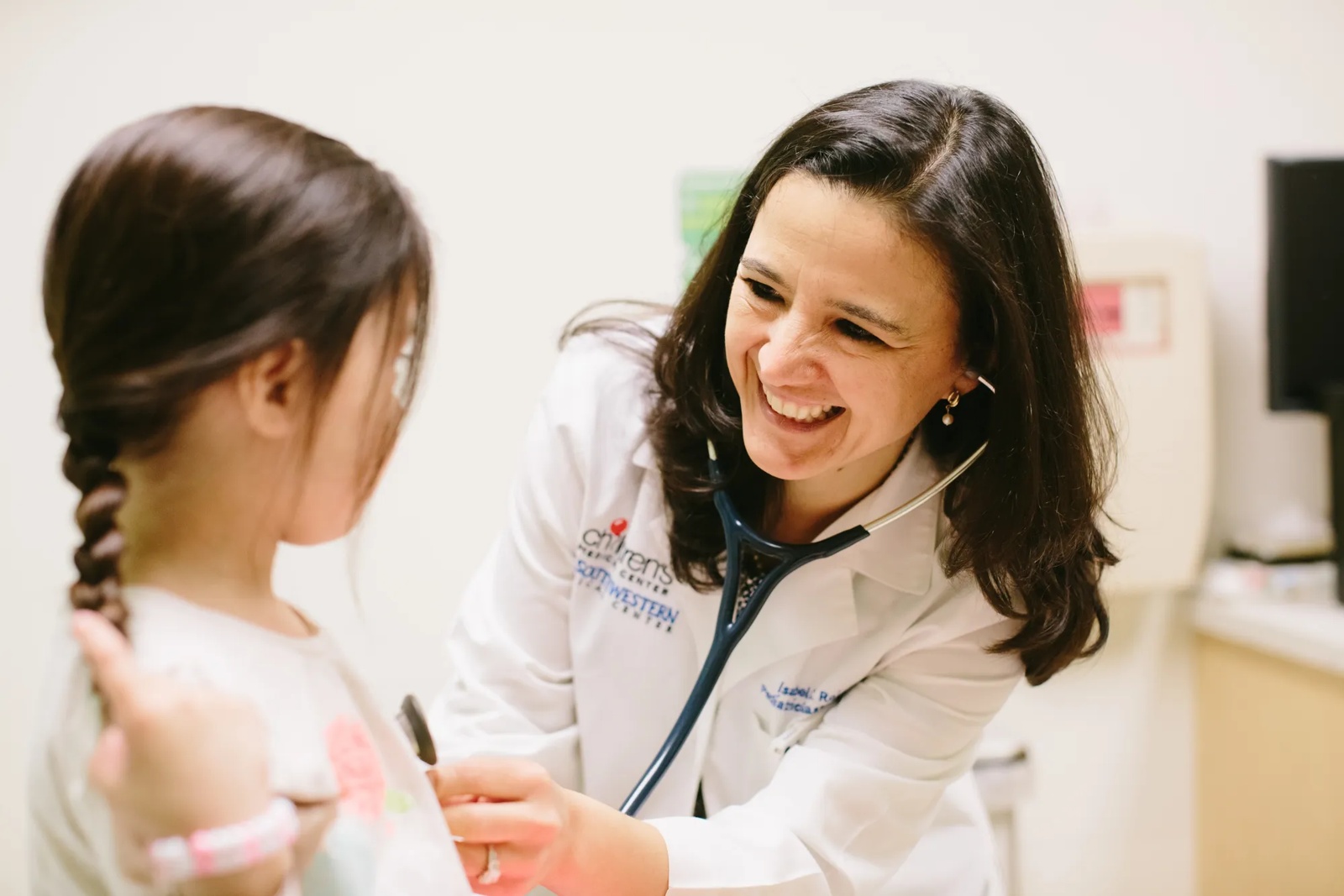
A team approach to care
At Children’s Health, your child has a full team to support them. Your child’s providers work together to figure out what treatment is best for your child and their needs. They each can review your child’s test results, progress and visit notes so that everyone is on the same page and working toward the same goal. With one team in one location, we can offer convenient, comprehensive care.
Comprehensive weight loss support
Achieving and maintaining a healthy weight is the most important thing your child can do to reverse this disease and improve their health. We offer multiple tools to help your child lose weight, including:
Family appointments with a registered dietitian to learn about nutrition
Counseling from a psychologist who specializes in weight loss
COACH Program for intensive weight loss support
Medicines that can help children achieve a healthy weight
Bariatric surgery options for teenagers
Your doctor can help you and your child decide which path to weight loss is best for them.
Advanced diagnostic tools
To ensure your child gets the right treatment, we need to have the right diagnosis. That’s why we use the latest tools to learn about your child’s liver health. We offer diagnostic testing such as:
MRI elastography, a radiation-free, noninvasive imaging test that uses sound waves and magnetic imaging to create a detailed map of your child’s liver
Endoscopic ultrasound-guided liver biopsies that use no incisions and have a fast recovery time
Transient Elastography (Fibroscan) that can provide a non-invasive assessment of the liver fibrosis during every clinic visit
A team approach to care
At Children’s Health, your child has a full team to support them. Your child’s providers work together to figure out what treatment is best for your child and their needs. They each can review your child’s test results, progress and visit notes so that everyone is on the same page and working toward the same goal. With one team in one location, we can offer convenient, comprehensive care.
Comprehensive weight loss support
Achieving and maintaining a healthy weight is the most important thing your child can do to reverse this disease and improve their health. We offer multiple tools to help your child lose weight, including:
Family appointments with a registered dietitian to learn about nutrition
Counseling from a psychologist who specializes in weight loss
COACH Program for intensive weight loss support
Medicines that can help children achieve a healthy weight
Bariatric surgery options for teenagers
Your doctor can help you and your child decide which path to weight loss is best for them.
Advanced diagnostic tools
To ensure your child gets the right treatment, we need to have the right diagnosis. That’s why we use the latest tools to learn about your child’s liver health. We offer diagnostic testing such as:
MRI elastography, a radiation-free, noninvasive imaging test that uses sound waves and magnetic imaging to create a detailed map of your child’s liver
Endoscopic ultrasound-guided liver biopsies that use no incisions and have a fast recovery time
Transient Elastography (Fibroscan) that can provide a non-invasive assessment of the liver fibrosis during every clinic visit
MASLD, previously known as non-alcoholic fatty liver disease, has become the most common cause of liver disease in children. It can lead to liver damage and even liver failure when left untreated.
Fortunately, our experienced care team can help children reverse MASLD by working on their diet and helping them change their lifestyle, which allows them to achieve a healthy weight. At Children's Health℠, we offer comprehensive weight management, from nutrition counseling to bariatric surgery. We work to empower your child to live a healthy life with care in a positive, judgment-free environment.
Our program offers the latest diagnostic technology and the most advanced surgeries to care for your child’s liver. We have the tools, experience and compassion your child needs for a healthier liver and a healthier life.