Cardiac Catheterization and Intervention
nationally ranked care, close to home
Meet the Care Team
Patient Stories
Millie's story: Expert heart care with a little help from a stuffed snowman
At 8-years-old, Millie’s mom describes her as a force of nature. She’s in her school’s gifted and talented program, part of the student council and loves playing soccer and basketball.

Conditions We Treat
Pediatric aortic stenosis
Pediatric arrhythmias
Atrial septal defect (ASD)
Atrioventricular septal defects (AVSD)
Pediatric cardiomyopathy
Coarctation of the aorta (CoA)
Congenital coronary artery anomaly (CAA)
Hypoplastic left heart syndrome (HLHS)
Pediatric patent ductus arteriosus (PDA)
Pulmonary atresia
Pulmonary stenosis
Tetralogy of Fallot (TOF)
Total anomalous pulmonary venous return (TAPVR)
Transposition of the great arteries
Tricuspid atresia
Truncus arteriosus
Ventricular septal defect (VSD)
Treatments & Services
Pediatric ventricular assist device (VAD)
Pediatric cardiac catheterization
Pediatric coarctation of the aorta (CoA) repair
Pediatric cardiac imaging
Ablation
Amplatzer
Angiogram
Arch Advancement
Balloon Angioplasty
Balloon Aortic Valvuloplasty
Biopsy
Coarctectomy
COAST Covered Stent
Defect Closure
Diagnostic Evaluation
Heart Valve Repair and Replacement:
Helex Device Closure
Patch Closure
Pre-Surgical Testing
Radiofrequency Ablation
Right Ventricular to Pulmonary Artery Conduit
Ross Rrocedure
Transannular Patch
Transcatheter Pulmonary Valve Implantation
Valve-Sparing repair
More Details
Cardiac catheterization is a safe, minimally invasive way to evaluate and treat many pediatric heart problems – even in high-risk children with complex conditions. Our cardiac catheterization intervention unit is one of the most experienced in the country. Our expert doctors perform about 750 pediatric cardiac catheterization procedures each year.
This gives us the experience to help your child overcome a heart problem and quickly get back to normal activities. It also means parents and caregivers don’t have to worry about taking lots of time away from work or other commitments.
Cardiac catheterizations and interventions repair heart conditions in children and infants
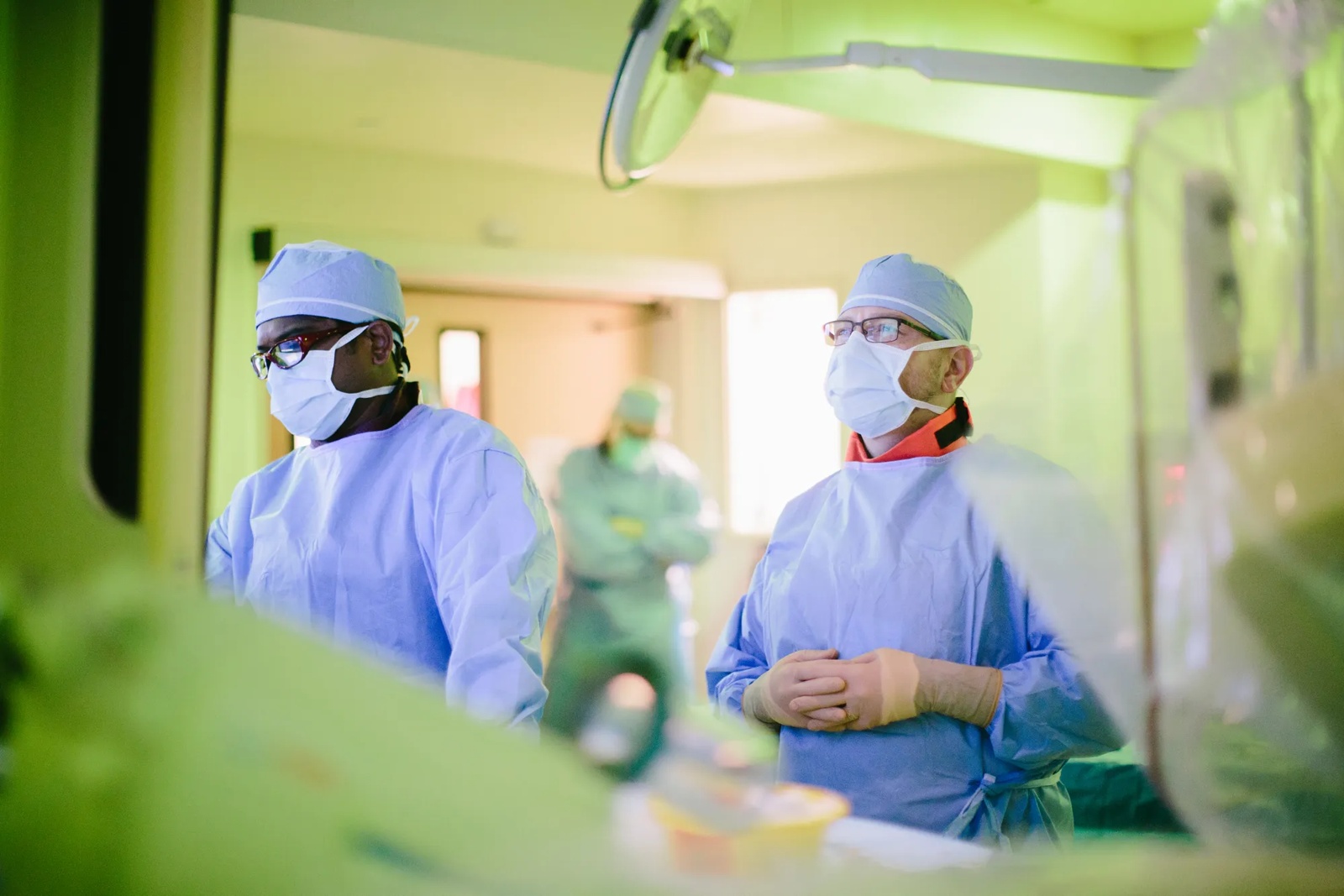
Catheters are thin, spaghetti-like hollow plastic tubes. Doctors use these catheters to guide tiny cameras, tools and devices through an artery or vein and into the heart. This lets doctors diagnose and repair heart issues in a way that is safer and easier to recover from than traditional open-heart surgery.
In the Children's Health℠ cardiac catheterization lab (cath lab), we can use catheter-based procedures to:
Dilate (widen) heart valves that are too narrow
Dilate narrowed arteries and veins
Insert stents (small tubes made of plastic or metal) to keep lung and body arteries open
Insert artificial valves to replace heart valves that aren’t working well
When are cardiac catheterization interventions performed?
We perform pediatric interventional cardiac catheterizations when a child has a heart problem that needs to be evaluated or fixed. Catheterizations can be done on children and infants.
World-renowned pediatric cardiologists
Our affiliation with UT Southwestern means that your child has access to some of the world’s top doctors specializing in pediatric heart conditions.
Innovative pediatric cardiac catheterization technology
If your child needs a cardiac catheterization intervention, you’ll be comforted to know that we use the latest technology to make these procedures as safe and effective as possible.
For example, we use cath lab imaging technology that significantly reduces radiation exposure. We also use additional screening imaging, such as CT or MRI, that can be “overlayed” on top of the X-ray imaging, reducing the time needed for the procedure, exposure to radiation and the contrast (dye) used.
In some cases, we use a technique called MRI-guided catheterization. This helps our doctors safely guide the catheter into your child’s heart, while reducing the use of X-rays during catheterization procedures. This may help reduce your child’s total exposure to radiation over their lifetime.
In addition, we may use 3D printing to create an exact replica of your child’s heart. Our doctors use this model to better understand the structure of your child’s heart. They can also use this model to practice your child’s procedure ahead of time, which can make the procedure faster and reduce the need for anesthesia.
Access to state-of-the-art research
Our physicians are constantly working to develop new procedures and devices through groundbreaking research. This means your child will get access to the latest technologies, leading to better outcomes and reducing the need for multiple surgeries.
We’re often among the first to use treatments that later become the national standard of care. We are currently:
Studying an innovative heart procedure on pediatric patients with congenital heart disease using a new type of heart valve stent that would allow more patients to avoid open heart surgery
Conducting preclinical studies for the only pediatric percutaneous ventricular assist device (VAD) available – a type of mechanical pump inserted with the help of a catheter that helps the heart circulate blood.